






The Six Dimensions of the ENRICH Method™
Each dimension is interconnected. Together, they form a complete picture of who you are. Click any dimension to learn more.
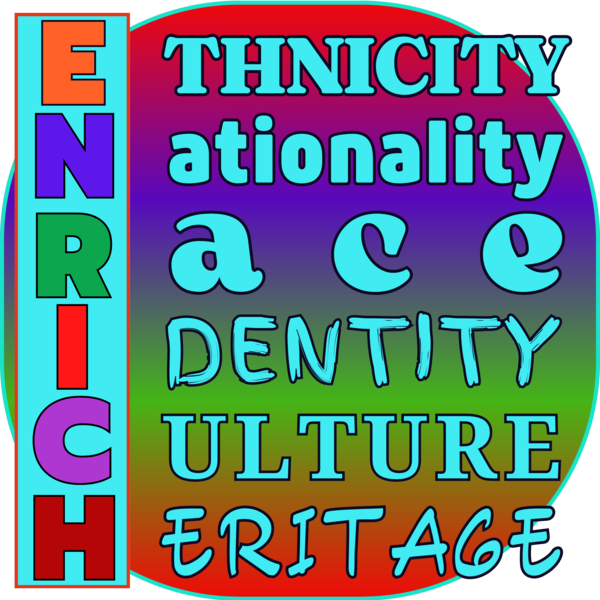
Six Dimensions. One Whole You.
Method™
Click any dimension to explore
The Six Dimensions
Ethnicity
Ethnicity encompasses your ethnic traditions, ancestry, lineage, and tribal affiliation. It is the cultural inheritance passed down through generations—the specific practices, languages, and customs that define your people's identity. Your ethnic roots shape how you understand belonging, family structure, spiritual practice, and your place in the world. They inform your values before you ever choose them.
Key Question: What ethnic traditions have shaped your sense of self and belonging?
Cultural Examples: Caribbean patois and cooking traditions. African drumming and naming ceremonies. South Asian joint family structures and festival celebrations. Latinx compadrazgo (godparent) systems.
Nationality
Nationality is your country of origin and the national identity that comes with it. It includes your migration history—whether you were born elsewhere, came as a child, or are part of a diaspora. National narratives shape how you see yourself as a citizen, immigrant, or outsider. They determine which doors are open to you and which walls you must navigate. Your national story is also a political story.
Key Question: How does your national origin shape how you move through the world?
Cultural Examples: First-generation immigrant experiences and documentation status. Post-colonial national identity and historical trauma. Diaspora communities maintaining connections across borders. Multi-national identities and belonging.
Race
Race is your racialized experience in the world—how you are perceived and treated based on your appearance. It encompasses the systemic impacts of racism and colorism on your life trajectory, safety, and access. Race shapes how you navigate institutions, form relationships, and protect yourself. It is not about biology; it is about power and history. Your race is inseparable from your daily experience.
Key Question: How has your racialized experience shaped your emotional patterns and self-perception?
Cultural Examples: Anti-Blackness across African diaspora communities. Colorism within communities of color. Asian stereotyping and "model minority" burden. Indigenous erasure and sovereignty struggles. Latinx categorization and border experiences.
Identity
Identity is your personal sense of self—the multiple roles you hold and the way you see yourself. It includes gender, sexuality, generation, profession, and the intersections between all of these. Identity is not fixed; it evolves as you gain self-understanding. It is also relational: you show up differently with different people. Identity is where you claim your power and where you sometimes lose it.
Key Question: Which parts of your identity are you free to express, and which do you hide?
Cultural Examples: LGBTQ+ identity within traditional family structures. Gender role expectations and transgression. Generational differences and "American" assimilation. Professional identity vs. home identity. Intersectional identity claiming.
Culture
Culture is the shared values, beliefs, and practices that create the rules governing your life. It is both explicit (celebrations, rituals, rules) and implicit (how emotions are handled, what success looks like, how relationships work). Culture shapes what feels normal, what feels wrong, what deserves shame, and what deserves celebration. Culture is how you know who you are—until you question it.
Key Question: Which cultural values were you taught, and which ones do you actually want to live by?
Cultural Examples: Collectivist vs. individualist family systems. Emotional expression norms. Relationship and marriage expectations. Work ethic and achievement culture. Spiritual and religious practice.
Heritage
Heritage is what your ancestors passed down to you—the inherited wisdom, intergenerational patterns, and unresolved trauma that lives in your body. Some heritage you received explicitly; much of it came through silence, behavioral modeling, and family secrets. Your heritage includes both the gifts (resilience, joy, spiritual practice) and the wounds (survival strategies that no longer serve you). Understanding your heritage is understanding yourself at a deeper level.
Key Question: What patterns did your ancestors survive, and how are they showing up in your life now?
Cultural Examples: Intergenerational trauma from colonialism, slavery, and war. Resilience practices passed through family stories. Spiritual and healing traditions. Family secrets and what was never spoken about. Adaptive strategies that became wounds.
Every dimension has an inner life. Go deeper into what the ENRICH Outsider carries beneath the six lenses.
Enter the ENRICH Outsider Lexicon →
Psychoeducation Before (and Beyond) Therapy
ENRICH products are psychoeducational. They are therapeutic, not therapy. They help you understand yourself, your patterns, your history, and your possibilities. We believe that self-understanding comes first—clarity precedes change.
Validate
Your experience is real. Your feelings make sense.
Name
Language creates clarity. We name what you're experiencing.
Educate
Understanding the "why" behind your patterns.
Invite
What becomes possible now that you understand?
A Different Approach
Cultural Reclamation
These communities had healing practices BEFORE colonization. ENRICH honors that lineage and returns self-understanding tools to the people who were excluded from creating them.
Decolonizing Wellness
ENRICH does not import a Western therapy model. It builds from cultural reality, integrating psychoanalytic depth with collectivist wisdom traditions.
Community-First Wellness
Collectivist cultures don't heal individually the way Western psychology assumes. ENRICH respects this by centering family, community, and cultural identity.
Coming Home
ENRICH is not an American company exporting Western psychology. It is cultural knowledge, from the Caribbean to Africa, Latin America, and Asia, returning with clinical structure.
Sovereign Intelligence™ — The Intelligence Behind the Method
The ENRICH Method is powered by Sovereign Intelligence™ — clinician-directed, culturally foundational, AI-assisted but never AI-dependent, and accountable to the communities it serves.
Clinician-Directed, Not Generated
Every response across all 100 companions is directed by Sherry Jerimie, Licensed Psychotherapist and Certified Psychoanalyst, through a clinician-authored system prompt that shapes a live AI layer. The intelligence comes from nearly 30 years of clinical practice with the Global Majority.
Data Sovereignty
Your conversations are sent to a live AI service to generate each response, but no conversation history is stored on an ENRICH server after your session ends. Your stories are not used to train any model. Your healing space is sovereign — it belongs to you, not to a tech company.
Auditable & Accountable
Unlike AI-generated text, every ENRICH response can be traced, reviewed, and improved. A licensed clinician stands behind every word.
Embodied Intelligence
AI can generate text about intergenerational trauma. It cannot understand what it means to carry your grandmother’s silence in your own throat. Our clinician can.
The ENRICH Safety Standard™
Every ENRICH product is built with seven foundational pillars of safety:
Airlock Entry
You enter safely, with preparation and grounding before any intense content.
Capacity Assessment
We assess your readiness and current emotional capacity before proceeding.
Daily Limits
Built-in boundaries protect you from overwhelming yourself through overuse.
Pulse Checks
Regular check-ins throughout content to ensure you're staying regulated.
Exit Ramps
You can always pause or exit content without penalty or judgment.
Grounding Tools
Evidence-based tools integrated into every session to keep you anchored.
Crisis Resources
If you're in crisis, immediate resources and support pathways are available.
Experience the ENRICH Method™
Choose the path that fits where you are right now.